 Parastoo Legal Group
Approved in Under 20 Days (2026): an Iranian Freelancer's Three-Year Digital Nomad Residence, With No Requerimiento
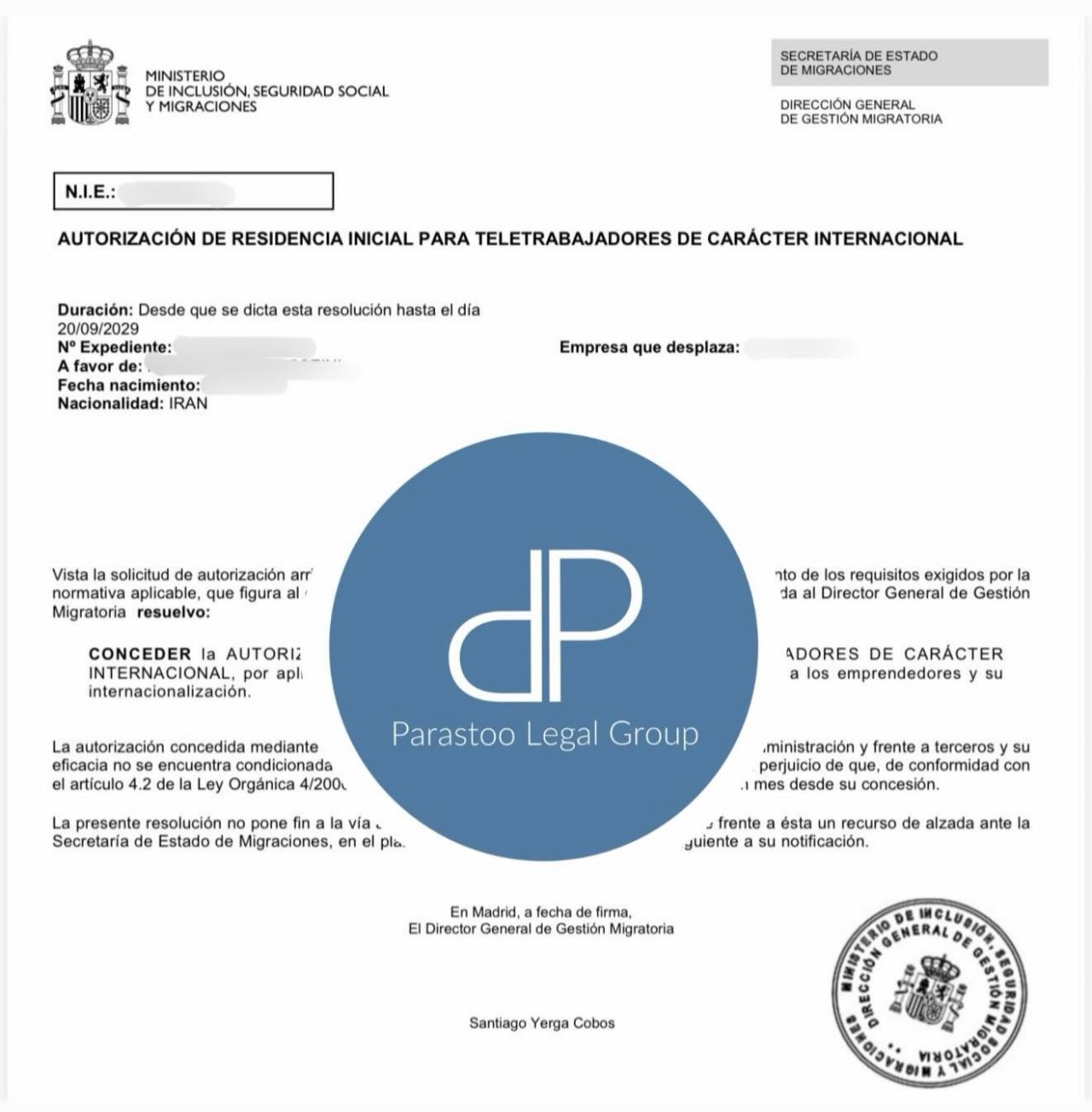
A real case, anonymised and published with the client's permission: an Iranian freelancer's digital nomad residence, filed at the UGE-CE in 2026 and approved in under 20 days, for three years, without a single request for further documents.
Most files that stall at Spain's Large Companies and Strategic Groups Unit (UGE-CE) do not stall because something is missing in substance; they stall because the case officer cannot find it, or because two documents tell slightly different stories. This case shows what a file from an Iranian freelancer looks like when it is built to be read in one sitting, and why it went through without a requerimiento.
At a glance
- Profile: Iranian citizen, self-employed, working remotely for clients established outside Spain.
- Route: international teleworker residence authorisation (Digital Nomad Visa), applied for from inside Spain at the UGE-CE.
- The risk: a file from an Iranian applicant typically draws a requerimiento (a request for further documents) on the self-employed evidence, the income trail or the Iranian document chain, which stops the clock and can add weeks.
- What we did: a complete file with every Iranian document legalised and translated in advance, plus a one-page cover note addressed to the case officer summarising the key points of the application and stating where each document is in the file.
- Result: approved directly by the UGE-CE in under 20 days, with no request for further documents, for three years.
- Timeline: approved in under 20 days from electronic filing, within the legal period for UGE-CE authorisations (20 days, with silence counting as approval).
Why this file was approved without a requerimiento
- Self-employed status, evidenced where the client lives. The file showed the applicant's own activity and the record that proves it, legalised through the Iranian chain (Ministries of Justice and Foreign Affairs, sworn translator on the Tehran embassy's list, Embassy of Spain in Tehran) before anything was filed.
- Clients that exist. Contracts with companies established outside Spain for more than a year, a working relationship older than three months, and invoices and bank credits that matched the contracts.
- The cover note. One page, addressed to the instructor: who the applicant is, which route, the three facts that make the file eligible, and a document index with page references. It is not required by the regulation; it is the single cheapest thing that reduces requerimientos.
- Two police certificates, one declaration. Certificates for the countries of the last two years and a signed declaration for the previous five, ordered in the right sequence so that none expired before filing.
What the law says
Law 14/2013, as amended by Law 28/2022, creates the international teleworker residence for professionals who work remotely for companies outside Spain using only digital means. Applied for from inside Spain, the authorisation is granted for three years and renewable for two; the UGE-CE must decide within 20 days of electronic filing, and silence counts as approval. Self-employed applicants may also work for clients in Spain provided that work stays below 20% of their total activity. Income in 2026: €2,849 a month for the main applicant, €1,068 for the first family member and €356 for each additional one.
If you are in a similar position
If you are an Iranian freelancer, in Iran or in the diaspora, with real foreign clients and a way to evidence that you are self-employed (your own company or licence, or your Iranian self-employed social security record), the in-Spain route is usually the one to plan for. The two things that decide the outcome are sequencing the Iranian document chain early and presenting the file so that it can be read without a single question. Our Digital Nomad Visa service, the guide for Iranian freelancers and the guide for Iranian freelancers in Dubai explain both.
Disclaimer
Real case, anonymised and published with the client's permission. Every file is decided on its own facts by the Spanish authorities; a past approval does not predict the outcome of another application.
Frequently asked questions
What is a requerimiento at the UGE-CE?
A formal request for further documents or clarification issued during the procedure. It pauses the legal period and typically adds weeks to a file; a complete, well-indexed application is the best way to avoid one.
Can an Iranian freelancer apply from inside Spain?
Yes. The applicant enters Spain on a Schengen visa with the file already complete and lodges the application electronically at the UGE-CE within the period of stay. We confirm the entry and stay position for each client before the Schengen visa is requested.
How is self-employed status proved for an Iranian applicant?
Through the applicant's own company or licence, or through the Iranian self-employed social security contribution record, legalised and translated through the Tehran chain.
Does a cover note really make a difference?
It is not required by the regulation, but a one-page note that states the key facts and indexes the documents helps the case officer read the file in one sitting, which is where most requerimientos are avoided.
How long does the UGE-CE take to decide?
The law sets 20 days from electronic filing, with silence counting as approval. The real timeline is set by how long the documents take to legalise before filing.
Sources
- Law 14/2013 on support for entrepreneurs and their internationalisation (consolidated text, BOE)
- Law 28/2022 on the promotion of the start-up ecosystem (BOE)
- Large Companies and Strategic Groups Unit (UGE-CE), Ministry of Inclusion
- Embassy of Spain in Tehran (sworn translators and legalisation)
Reviewed by Daniel Monfared, Founder & CEO · 8 November 2026
Figures stated are those in force at the date of publication. This article describes one anonymised case and is general information, not legal advice on an individual case.